

Containment Before Identity: Reading the Systems of Into the Unwell
How systems are built, restrained, and only then given meaning.

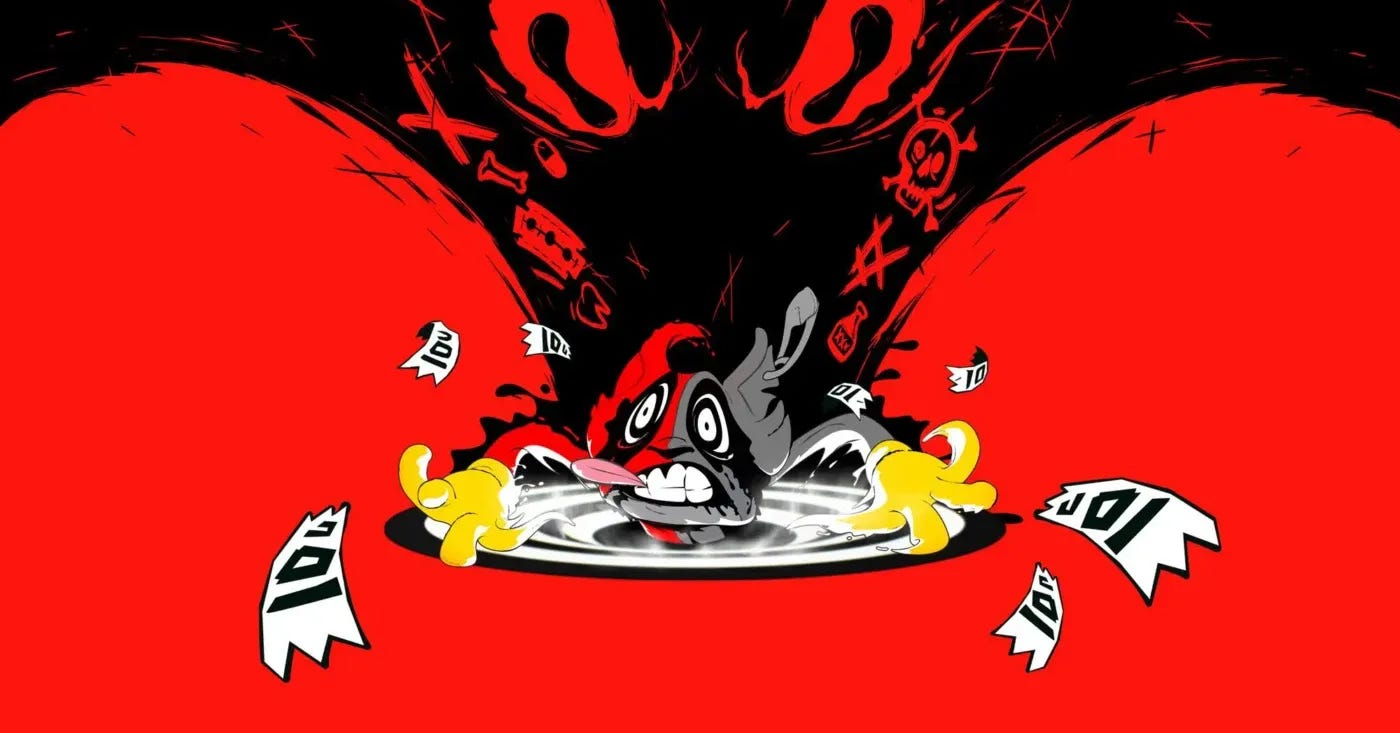
Into the Unwell announces itself as chaos. A rubber-hose third-person roguelite about alcoholics, depressives, and a heavily medicated cat, fighting through a world that mirrors their own unwellness back at them — it’s the kind of premise that could collapse into either edgy provocation or shapeless slapstick. Talking to Mårten Stockhaus, co-founder and creative director at She Was Such a Good Horse, a different shape emerges, one that shows up again and again under different names: a weapon, a button, a piece of UI. Something gets built loosely, gets watched, gets restrained, and only after the restraint holds does the studio decide what it means. Call it containment before identity. It’s not a slogan the studio would use about itself — Stockhaus never names it — but it’s the gesture that recurs across nearly every system he describes, and it’s worth tracking as a single thread rather than four separate anecdotes.
The premise that arrives before its own justification
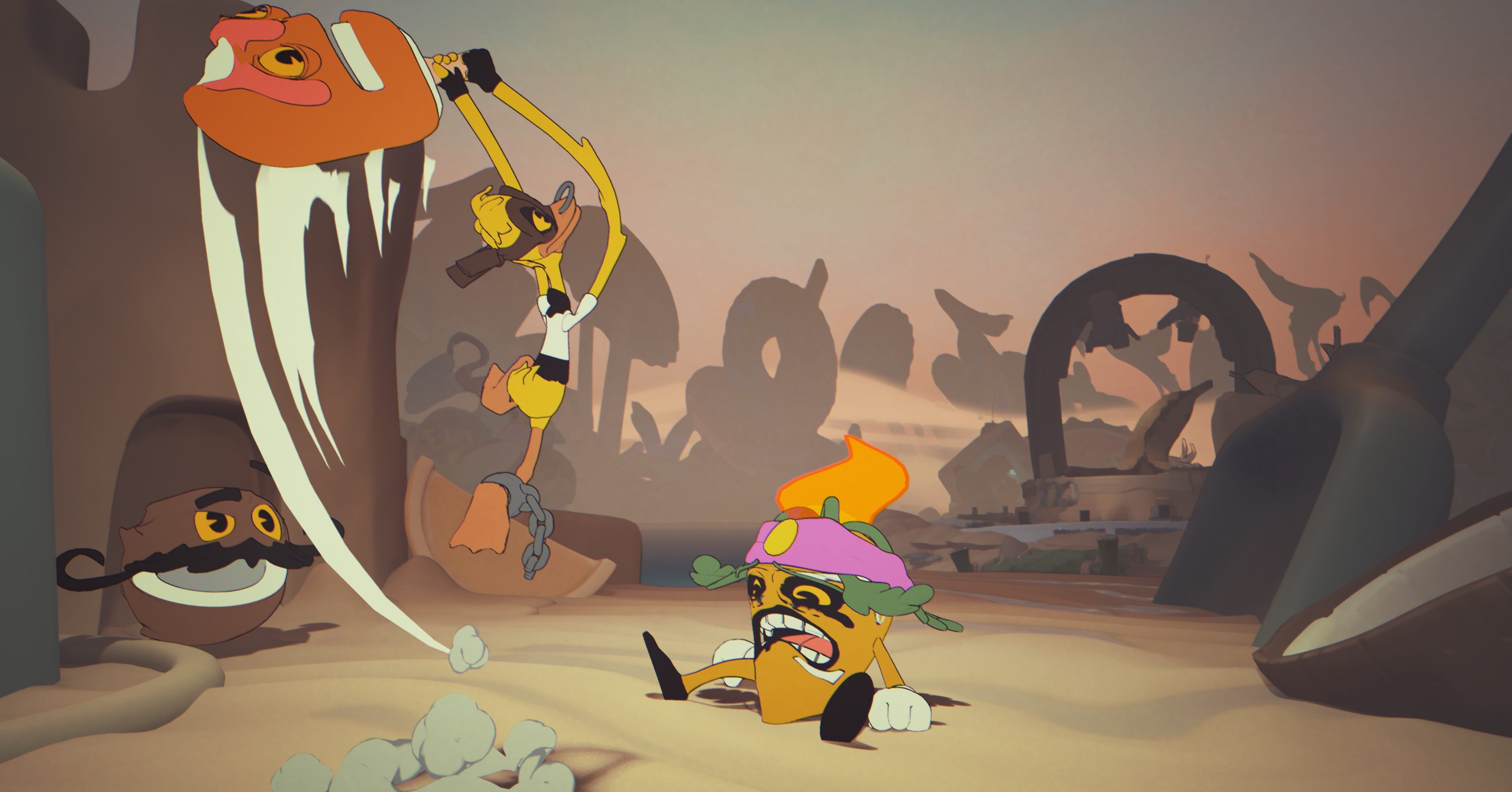
“Power from powerlessness” is not a new pitch. Darkest Dungeon turns stress and fear into a resource to be managed rather than eliminated; Hades treats grief and family dysfunction as the engine of its loop rather than an obstacle to it; Hellblade folds psychosis directly into how the player perceives the game’s space. Into the Unwell sits in that lineage, but pushes further into discomfort by naming addiction and depression specifically, and by declining to soften the choice with metaphor — the cat is medicated, the heroes are drunks, full stop.
What’s notable is how little appetite Stockhaus has for examining where that choice came from. The idea arrived, by his account, “a little too easy and too early,” over beers, and his response to being asked why is to wave the question off: “it’s better not to speculate too much.” Read one way, that’s a creative director declining to over-intellectualize an instinct that worked. Read another way, it’s the premise undergoing the same containment-before-identity logic as everything else in this interview — except here the thing being contained isn’t a mechanic, it’s the studio’s own account of its motives. The idea is allowed to exist and produce results before anyone is asked to justify it.
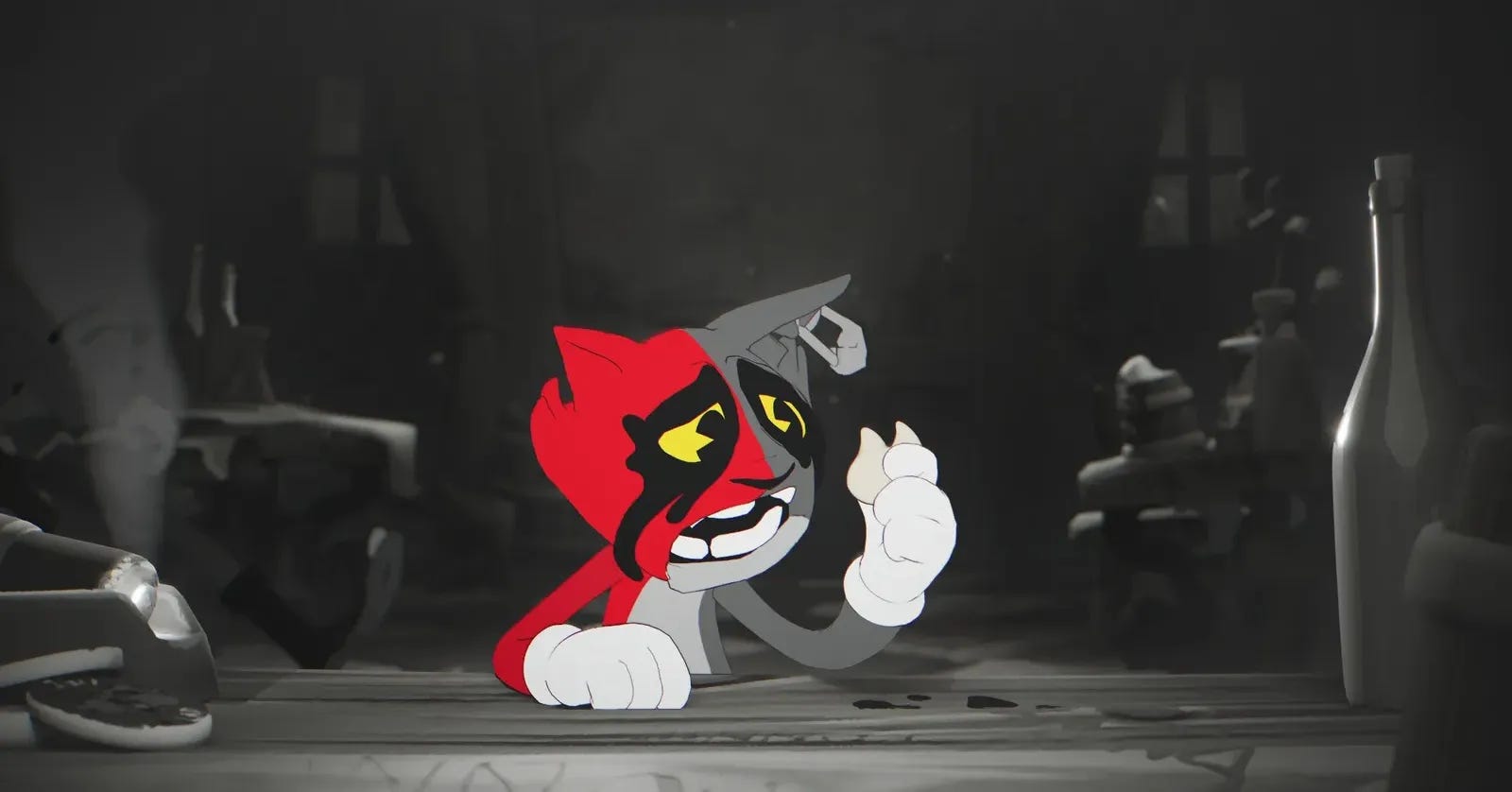
Where the thesis gets more concrete is the smallest example offered: Charcat, the depressed house cat whose “runny eyes and split color say so much using so little.” That’s not a thematic claim so much as a legibility claim — vulnerability, to function as a game asset rather than a mood board entry, has to be readable at a glance, the way an attack telegraph or a status icon is readable at a glance. It’s the first place the abstract premise gets a body.
A weapon, a button, and the model that connects them
The pattern is most visible — and most useful as a model — in two systems Stockhaus describes from very different angles: a weapon and a button.
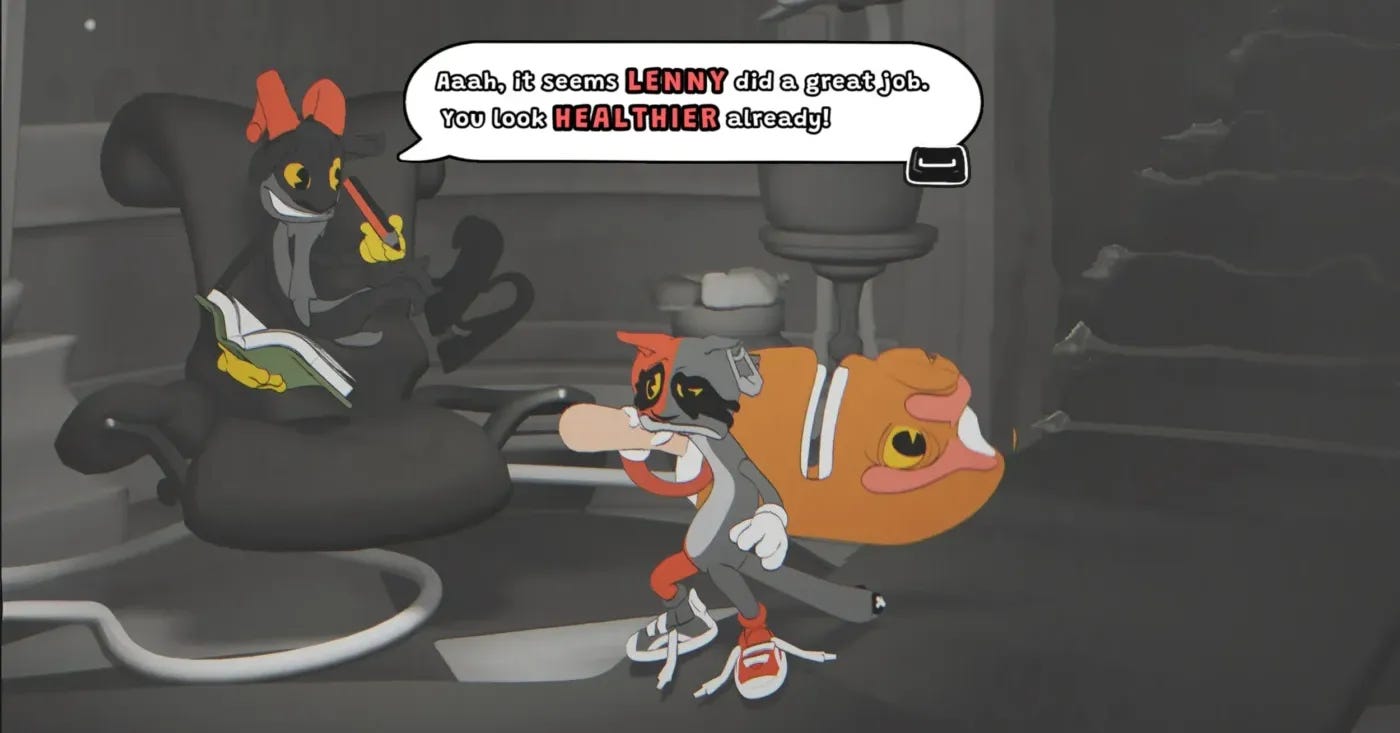
The ice cream weapon wasn’t designed to be charming and then mechanically realized; it was built to fill a gap in playstyle, and its temperament — “charming,” “charisma and grace” — was read off the finished model afterward, the way you’d describe a stranger’s face before you’d spoken to them. The “lobotomised lollipop” presumably went through something similar, though its name carries a sharper, more clinical edge than “charming” does, and the interview never quite reconciles that gap between the studio’s most affectionate weapon and its most unsettling one. Worth sitting with rather than smoothing over: a game built on vulnerability-as-power keeps producing objects that are simultaneously cute and a little disturbing, and the studio doesn’t appear to be choosing one register over the other so much as letting both stand, uncontained, side by side.
The kick mechanic tells the same story with sharper edges, and it’s the clearest single proof of the pattern in the whole interview. It started loose — a dedicated button to punt enemies into hazards, unrestricted. The team narrowed it, gating it behind a stun requirement. Only then did it expand back outward: status effects on the kick, additional charges, eventually entire builds organized around it. Open, restrict, then re-expand along a controlled axis. That sequence is the clearest articulation of containment before identity anywhere in the conversation — not because the kick is more important than the rubber-hose aesthetic or the co-op question, but because it’s the one system where the studio’s own account makes the mechanism visible step by step. Everything else in this piece is, in effect, a variation read through that same three-beat structure: open, restrain, let meaning accrue inside the restraint.
The legibility work Stockhaus describes for combat follows an identical logic, applied to noise instead of mechanics: identify whatever’s creating the worst visual clutter, then ask whether it’s earning its place. “We do like our drunken and chaotic brawls, but as everyone knows, within reason,” he says, and the qualifier is the whole sentence’s argument — what reads on screen as rubber-hose anarchy is the output of a studio repeatedly deciding what to cut. None of these systems were planned end to end on paper. They were grown, watched, and pruned, the identity assigned only once the containment was already in place.
Where the language stops being observable
The progression answer breaks the pattern, and the break is more useful than a clean fit would have been. Stockhaus describes three categories of upgrade — power, playstyle, feel — plus character-and-weapon-specific talents, plus run-to-run randomness. Every other system in this interview arrives with a named, inspectable artifact: the ice cream weapon, the kick button, Charcat. The progression answer arrives with none. No specific upgrade is named, no example of a “feel” change that isn’t also a power change, no talent pairing offered as evidence that two characters actually diverge rather than look different while playing the same.
That gap is the tell. Everywhere else, Stockhaus’s claims are observable — they point at a built thing and let the thing carry the argument. Here, the claim is declarative: a description of intent with nothing underneath it to verify against. That shift, from observable to declarative, is the single clearest signal in the interview of where containment hasn’t happened yet, or hasn’t happened in a way the studio is ready to show. It doesn’t mean the progression system lacks the variety being claimed for it. It means this is the one place where the interview asks to be taken on faith rather than shown the mechanism, and the asymmetry with the rest of the conversation is loud enough to flag rather than smooth over.
The question answered sideways
Asked directly whether three-player co-op reinforces or dilutes the game’s “inner demons” framing, Stockhaus answers a social question instead of the mechanical one — hoping multiplayer becomes a low-stakes way for friends to “casually start talking about” addiction and mental health. Generous, plausible, and not a description of what co-op does to the system. Three players each embodying a different flaw, coordinating to survive, is a structurally different claim than one player alone with a single flaw: it would mean vulnerability becomes collectively useful rather than privately so, a stronger thesis than the solo version if the mechanics back it up. Or co-op flattens the premise into ordinary cooperative competence — three classes doing damage together, with addiction and depression reduced to skins that would read identically on any other set of traits. Containment before identity would predict the studio hasn’t fully decided yet, that the social shape of co-op is still loose and the meaning is waiting to be read off it later, the same way the ice cream weapon’s charm was read off its finished model rather than planned in advance.
The “Unwell Nation” aside — players forming an in-joke government run by whichever character is the resident drunk — is the studio’s own unprompted image of where shared play naturally goes, and it’s worth taking at face value rather than as a throwaway. It’s chaotic and communal, and it is not a confrontation with anything. If that’s the genuine attractor state of co-op, the multiplayer mode is heading toward shared absurdity rather than shared catharsis — not a flaw, but a different game than the solo framing describes, and one whose containment, on this evidence, hasn’t closed yet. Stockhaus ends by wondering whether the characters ever get well, hoping the player does. The more interesting unanswered question by that point isn’t whether they get well — it’s whether three of them trying to get well together changes what “getting well” means inside this system at all, and that’s the one piece of containment this interview leaves entirely open.